
Permanecer é revolucionar
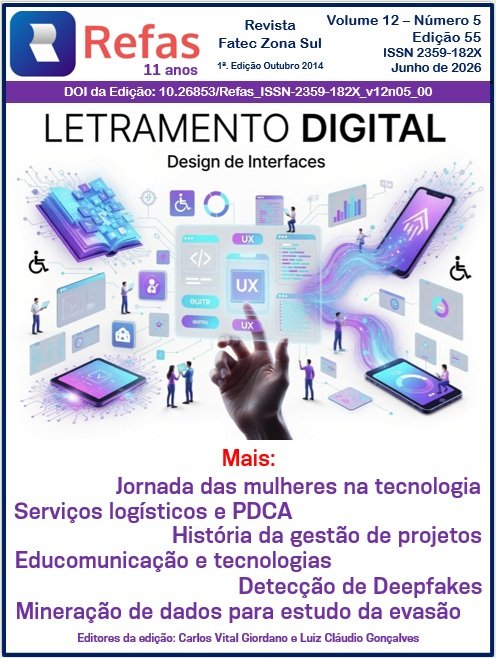
a jornada das mulheres na tecnologia
DOI:
https://doi.org/10.26853/Refas_ISSN-2359-182X_v12n05_03Keywords:
Women in technology, Female leadership, Gender equality, Labor Market, InnovationAbstract
The entry and retention of women in the technology sector has historically been marked by processes of invisibility, gender stereotypes, and structural asymmetries in the labor market. This article discusses the trajectory of women in technology from a theoretical-analytical perspective on the barriers faced and the recent transformations that reposition women as protagonists in strategic areas such as innovation, information security, governance, and technical leadership. Based on a literature review and contemporary perspectives on the sexual division of labor, mental load, intersectionality, and emerging management models, factors such as motherhood, work overload, and organizational rigidity impact the presence of women in decision-making positions are analyzed. The results show that, despite advances in representation and leadership, challenges related to corporate culture, the precariousness of autonomy at work, and the insufficiency of institutional equity policies persist. It is argued that the expansion of female participation cannot be understood merely as the occupation of space, but as qualified and sustained retention, anchored in real conditions of productivity, recognition, and advancement. It is concluded that promoting female leadership in technology requires not only inclusion initiatives, but also structural changes that value multiple roles, productive flexibility, and management models aligned with diversity.
Downloads
References
ACKER, Joan. Hierarchies, Jobs, Bodies: A Theory of Gendered Organizations. Gender & Society, v. 4, n. 2, p. 139–158, 1990.
ACKER, Joan. Gendering Organizational Theory. In: MILLS, A.; TANCRED, P. (org.). Gendering Organizational Analysis. Newbury Park: Sage, 1992.
ANITA BORG INSTITUTE. The 2022 Technical Equity Report. Palo Alto: ABI, 2022. Disponível em: <https://legacy.anitab.org/wp-content/uploads/2023/04/Anita-B-TechEES-2022-Report-FINAL-1.pdf>. Acesso em: 26 mar. 2026.
BERNARDES, Carolina. Mulheres na Computação no Brasil. Porto Alegre: SBC, 2022.
BRASIL. Lei nº 9.029, de 13 de abril de 1995. Proíbe práticas discriminatórias para efeitos admissionais ou de permanência no emprego. Diário Oficial da União, Brasília, 1995.
BRASIL. Lei nº 14.163, de 4 de junho de 2021. Institui o Programa de Incentivo à Participação Feminina em Tecnologias. Diário Oficial da União, Brasília, 2021.
BRASIL. Lei nº 14.611, de 3 de julho de 2023. Dispõe sobre igualdade salarial e critérios remuneratórios entre mulheres e homens. Diário Oficial da União, Brasília, 2023.
BRASIL. Ministério das Mulheres.Relatório nacional de políticas para igualdade de gênero. Brasília: MM, 2024.
BRASIL. Estratégia Brasileira para Inteligência Artificial – EBIA. Ministério da Ciência, Tecnologia e Inovações. Brasília: MCTI, 2021.
BRASIL. Plano Nacional de Internet das Coisas (IOT.Br). Brasília: Ministério da Ciência, Tecnologia e Inovações, 2020.
BUOLAMWINI, Joy; GEBRU, Timnit. Gender shades: intersectional accuracy disparities in commercial gender classification. In: CONFERENCE ON FAIRNESS, ACCOUNTABILITY AND TRANSPARENCY, 1., 2018, Nova York. Proceedings of Machine Learning Research. [S. l.]: PMLR, 2018. v. 81, p. 77–91.
CLANCE, Pauline Rose; IMES, Suzanne Ament. The imposter phenomenon in high achieving women: dynamics and therapeutic intervention. Psychotherapy: Theory, Research & Practice, v. 15, n. 3, p. 241-247, 1978.
CRENSHAW, Kimberlé. Demarginalizing the intersection of race and sex: a black feminist critique of antidiscrimination doctrine, feminist theory and antiracist politics. University of Chicago Legal Forum, Chicago, v. 1989, p. 139-167, 1989.
CRENSHAW, Kimberlé. Mapping the Margins: Intersectionality, Identity Politics, and Violence Against Women of Color. Stanford Law Review, v. 43, p. 1241–1299, 1991.
DAVIS, Angela. Mulheres, raça e classe. São Paulo: Boitempo, 2016.
EAGLY, Alice; KARAU, Steven. Role Congruity Theory of Prejudice Toward Female Leaders. Psychological Review, v. 109, n. 3, p. 573–598, 2002.
FEDERICI, Silvia. Calibã e a bruxa: mulheres, corpo e acumulação primitiva. São Paulo: Elefante, 2017.
HAICAULT, Monique. Carga mental e trabalho doméstico. Cadernos de Pesquisa, n. 63, p. 5–17, 1987.
HILL COLLINS, Patricia. Black feminist thought: knowledge, consciousness, and the politics of empowerment. New York: Routledge, 2000.
HIRATA, Helena; KERGOAT, Danièle. Novas Configurações da Divisão Sexual do Trabalho. Cadernos de Pesquisa, v. 37, n. 132, p. 595–609, 2007.
KELLER, Evelyn Fox. Reflections on gender and science. New Haven: Yale University Press, 1985.
MARCONI, Marina de Andrade; LAKATOS, Eva Maria. Fundamentos de metodologia científica. 7. ed. São Paulo: Atlas, 2010.
NEWPORT, Cal. Deep work: rules for focused success in a distracted world. New York: Grand Central Publishing, 2016.
RICHARDSON, Sarah S. Sex itself: the search for male and female in the human genome. Chicago: University of Chicago Press, 2013.
ROSSITER, Margaret. The Matthew Matilda Effect in Science. Social Studies of Science, v. 23, n. 2, p. 325–341, 1993.
SCHIEBINGER, Londa. Has Feminism Changed Science? Cambridge: Harvard University Press, 1999.
SENNETT, Richard. A corrosão do caráter. Rio de Janeiro: Record, 1999.
SEVERINO, Antônio Joaquim. Metodologia do trabalho científico. 23. ed. São Paulo: Cortez, 2007.
UNESCO. Cracking the code: Girls’ and Women’s Education in STEM. Paris: UNESCO, 2017.
WOMEN IN TECH BRASIL. Panorama da participação feminina em tecnologia. São Paulo: WITBR, 2023. Disponível em: <https://womenintech.com.br>. Acesso em: 26 mar. 2026.
Downloads
Published
How to Cite
Issue
Section
License
Copyright (c) 2026 Refas - Revista Fatec Zona Sul

This work is licensed under a Creative Commons Attribution 4.0 International License.
1 - As fontes dos dados, as autorizações pertinentes e os textos publicados na revista são de inteira responsabilidade de seus autores.
2 - É permitida a reprodução, desde que citada a fonte e o autor.
3 - Após o artigo aprovado, o autor principal deverá enviar declaração, conforme o modelo:
Refas - Revista Fatec Zona Sul
Autorização par publicação
(Nome do autor), (no caso de vários autores citar todos), autorizo (ou autorizam, no caso de diversos autores) a publicação do artigo (nome do artigo), com exclusividade para a primeira publicação pela Revista Fatec Zona Sul, em meio eletrônico.
A contribuição é original e inédita, e não está sendo avaliada para publicação por outra revista; caso contrário, deve-se justificar em "Comentários ao editor".
Dados de todos os autores:
Nome completo:
Instituição:
E-mail:
Telefone:
Obs.: Informar os códigos dos serviços DDD e DDI.
Assinatura do autor principal: ____________________________________
Aviso de Direito Autoral
Autores que publicam nesta revista concordam com os seguintes termos:
a) Autores têm autorização para assumir contratos adicionais separadamente, para distribuição não-exclusiva da versão do trabalho publicada nesta revista (ex.: publicar em repositório institucional ou como capítulo de livro), com reconhecimento de autoria e publicação inicial nesta revista.
b) Autores têm permissão e são estimulados a publicar e distribuir seu trabalho online (ex.: em repositórios institucionais ou na sua página pessoal) a qualquer ponto antes ou durante o processo editorial, já que isso pode gerar alterações produtivas, bem como aumentar o impacto e a citação do trabalho publicado.
c)Autores mantém os direitos autorais e concedem à revista o direito de primeira publicação, com o trabalho simultaneamente licenciado sob a Licença Creative Commons CC Attribution 4.0, acessável em Licença Creative Commons Attribution, que permite o compartilhamento do trabalho com reconhecimento da autoria e publicação inicial nesta revista.